
How to Search Criminal Dockets
Begin at the official Coweta State Court Case Management Search/Copies page. It covers civil, criminal, and traffic inquiries through the county's case-management route. The State Court disclaimer is the intended first screen. Its SearchByParty, SearchByAParty, and SearchByCaseNumber options do not currently present working forms. Treat that as an access gap rather than a working public docket search.
Sort the case first. It may sit in State Court, Superior Court, or a city municipal court. Or it may sit in Juvenile Court. It may also appear in a federal docket. Try spelling variations only if a live official system accepts them. For help, the disclaimer lists 770-254-2690, while the State Court Clerk's published number is 770-254-2699. These are different offices. When a route fails, take the question to the clerk who actually keeps the record.
- Start with the official Case Management Search/Copies page and read the disclaimer before using any search control.
- Choose the live route for a party, associated party, or case number only if that route actually displays a working form.
- Enter the exact name or case number, then try an official spelling variation only when the live county system allows another search.
- Compare the court, calendar type, setting, charge, count, and later disposition instead of treating one calendar line as the whole case.
- When the route fails, call the State Court Clerk at 770-254-2699 or ask the appropriate clerk for the current docket or copy process.
Coweta's 2025 Criminal Intake Track
A Coweta criminal assignment order filed in 2025 adds a step. That step comes before a regular docket number exists. Uniform traffic citations, warrants, and warrantless affidavits that reach the State Clerk from November 10, 2025 get a unique tracking number before docketing. The file then goes to the Solicitor. That office makes a prosecution decision and a TVB or non-TVB classification. Judge rotation follows the local assignment process.
An early intake record and a later public calendar entry may not match. They may not even sit side by side. A tracking number is not a guilty finding. It is not a sentence or a replacement for the court-assigned case number. The Coweta e-filing information keeps criminal and traffic filing routes apart from public case management, so a vendor receipt is never the official real-time register.
Intake path: Filing or intake → tracking and classification → docketing → arraignment → later criminal settings.
What a Criminal Docket Shows
An anonymized Coweta Palmer arraignment calendar offers a local field model. It does this without exposing private party names. It breaks the report into court or calendar type, date and time, judge, item, attorney information, count, defendant field, case number, and offense or code count. Those labels show what a calendar report displays. Nothing there, on its own, establishes a plea, conviction, sentence, or final disposition.
| Report | The calendar report identifier that groups the listed setting. |
|---|---|
| Court or calendar type | The State or Superior Court context and the kind of criminal calendar. |
| Date and time | The scheduled setting, which may be an arraignment, motion, or trial calendar. |
| Judge | The judge assigned to the listed calendar or setting. |
| Item | The position of the matter on that report; more than one item can share a report. |
| Attorney(s) | Counsel information shown on the calendar, or a notation that representation is self-managed. |
| Count | The count label connecting an offense description to a charge count. |
| Defendant field | The party field used by the calendar; private sample names are omitted here. |
| Case number | A court-assigned identifier. A safe local Superior sample is 2025-SU-V-6-CJB. |
| Offense or code | The charge description or code line. It is not the same as a disposition or conviction. |
Do not try to decode the sample yourself. Only the clerk can confirm what a letter or suffix means. A report number and item simply organize the setting; they never create a second case.
Coweta's Palmer Criminal Report Fields
The Palmer report earns its keep. It shows how a criminal calendar compresses a whole case into a setting list. Court type, date, judge, and item place the event. Attorney and defendant fields name the participants in the court's own record, and the count plus offense or code fields show what is set that day. A careful reader then hunts for separate entries. Those entries cover plea, disposition, sentence, or a later probation event.
That separation is what keeps the record honest. A charge may sit pending, get amended, be dismissed, resolve by plea, or go to trial. The offense column picks none of those outcomes. The report is a window on a scheduled proceeding, not the full case file. For a certified copy or a question about a field, ask the clerk who maintains the State or Superior record instead of trusting an abbreviated sample.
Stages on a Criminal Docket
Read a Coweta criminal docket as a chain of procedural events. Locally, the flow runs from filing or intake to arraignment. Then come pretrial and motions. Next comes a plea, or a bench or jury trial, and finally disposition and sentence if the case gets that far. A setting can move a case forward without deciding anything. The next calendar date matters. Read it beside the event type and any later order.
Criminal docket flow: Filing or intake → arraignment → pretrial or motions → plea or bench/jury trial → disposition or sentence.
At arraignment, the court may take a plea and set the next stage. Motions take up the pretrial requests named in the standing order. A bench trial leaves fact-finding to the judge. A jury trial adds selection and trial before a jury. Each label names the event, never the result.
ARR, JAIL, and TVB Labels in Coweta Criminal Dockets
The 2026 Coweta State Court calendar and the criminal calendar standing order rely on short labels like these. Treat them as scheduling terms, not verdicts in miniature. When a label seems to clash with another document, the exact setting and the case record control.
- ARR
- Arraignment, a criminal setting for a plea or case status under the local order.
- INTER ARR
- Interpreter arraignment, a calendar category for an arraignment requiring interpreter handling.
- JAIL
- A jail-related arraignment or criminal calendar setting; it is not a disposition.
- TVB arraignment
- An arraignment category tied to the Traffic Violations Bureau process.
- CR MOT
- Criminal motion calendar, which can include the motion types named in the standing order.
- CR BT
- Criminal bench trial, where the judge serves as the fact finder.
A written waiver or absence request follows the same standing order. Get it in by noon on the prior business day. The request needs the title, plea, and calendar type. Add current mailing and email contact. Include a signature, date, and proof of service. Read the order itself rather than assuming you may skip a setting. A first arraignment may qualify for a limited Rule Nisi exception. Later status proceedings generally require attendance. Other labels may appear on a master calendar. Look for DUI TEAM, DUI COURT, CV PT, CV NJ, and CV/CR JT. When a term is unclear, confirm it with the current order or the clerk.
Which Court Holds Criminal Dockets
Which court holds the record? That question comes first in any Georgia criminal docket search. The official Georgia Courts navigation guide explains the split. State Court, it says, is the county-limited venue for misdemeanors, traffic, and warrants. It also takes preliminary criminal matters and civil matters not reserved to Superior Court. Superior Court handles the felonies, with broad criminal and civil jurisdiction. Neither route covers everything. A Coweta search through State Court alone will miss cases. Those criminal cases belong to Superior Court.
| Court | Criminal docket role | Access clue |
|---|---|---|
| State Court | County misdemeanors, traffic, warrants, and preliminary criminal matters. | State Court Case Management and the State Court Clerk. |
| Superior Court | Felony cases and broad criminal jurisdiction, including motions and trials. | Superior Clerk and Court Services; provider routes are separate from the official docket. |
| Juvenile Court | Delinquency, unruly or CHINS, truancy, and dependency matters. | Separate clerk and confidentiality rules under juvenile law. |
| Municipal courts | City traffic and ordinance matters, with city-specific criminal authority. | The issuing city's court and vendor route, not one county search. |
Magistrate Court keeps its own lower-court records for warrants and minor criminal matters. Federal cases are different again. Any district or bankruptcy matter heard in Newnan belongs to the Northern District of Georgia. Those dockets are federal, not Coweta county dockets. When you read a calendar, the court name matters as much as the party name.
Adult, Juvenile, or Specialty Coweta Criminal Courts?
Specialty courts handle some Coweta criminal matters. These are not ordinary adult State or Superior calendars. The county's Accountability Courts page describes Drug Court, DUI Court, Family Treatment Court, and Veterans Treatment Court as structured programs with their own treatment, dependency, or alternative-sentencing roles.
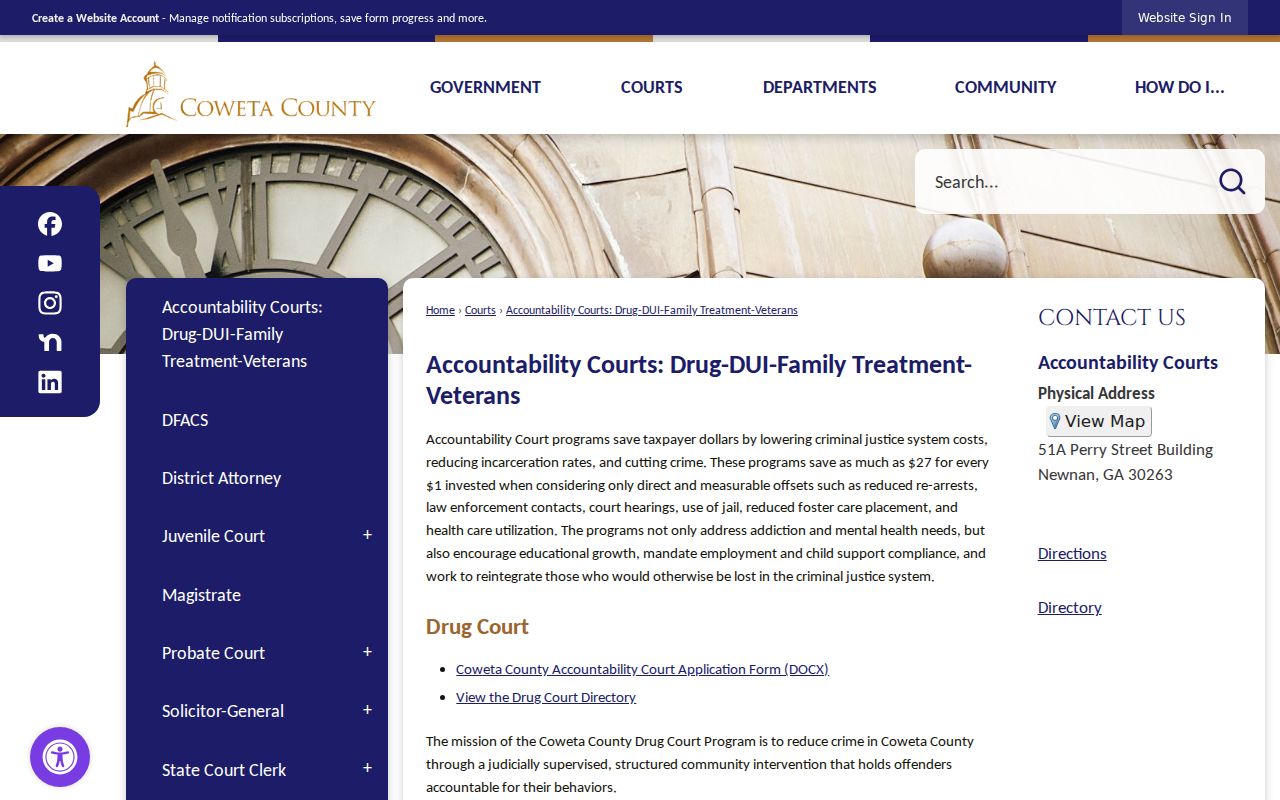
A specialty setting may not appear on an ordinary public criminal calendar. It does not replace the originating State or Superior record. Program documents follow their own access rules. Juvenile matters are a separate branch. Coweta's Juvenile Court information page describes security and access limits. Article 9 of the Georgia Juvenile Code controls confidentiality. The local JDEX route serves authorized users rather than an open public name search.
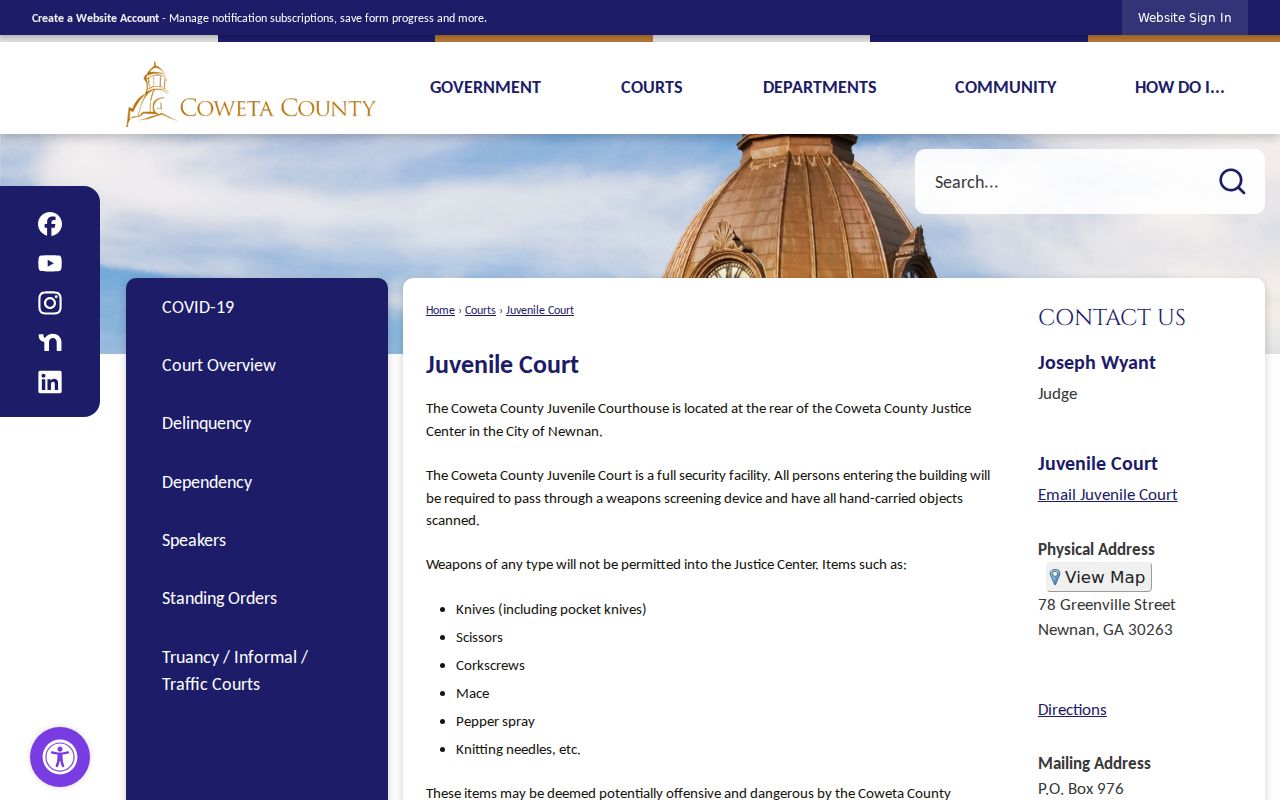
Juvenile confidentiality sets a legal boundary on access. It says nothing about whether an adult case-management link works or whether a missing adult result was sealed.
Public Access and Sealed Criminal Dockets
Openness is the default under Uniform Superior Court Rule 21. Court records stay open to the public unless law and procedure say otherwise. Any order that seals material or limits access has to name what is covered. It must also give the reason. The order sets the duration and states the legal basis. The order must also show that the protected interest clearly outweighs the public interest. Rule 21.6 covers protected identifiers under Georgia law. Access is one thing; copying sensitive identifiers into your notes is another. Public access does not permit it.
Record restriction works differently from a docket search. The official Georgia Courts record-restrictions resource explains O.C.G.A. §35-3-37. It also covers the limits on restricted criminal-history information. Keep one limit in mind. Restriction in one criminal-history source does not wipe away every docket entry in Coweta County court records. Juvenile Article 9 confidentiality adds its own layer of protection. Federal sealed documents answer to federal access rules instead.
Access rules to verify:
Uniform Superior Court Rule 21 sets a public-by-default standard and a specific order process for limiting access.
Rule 21.6 and O.C.G.A. §9-11-7.1 address protected identifiers that should not be copied into a public example.
O.C.G.A. §35-3-37 concerns record restriction for qualifying criminal-history information; it is not a universal deletion rule.
Juvenile Court access follows Article 9 confidentiality and authorized-user limits.
When a Coweta Criminal Docket Link Is Down
A 404 or 403 on the Coweta State Court search route is a technical gap. It is not proof of anything. Sealed, restricted, dismissed, and nonexistent are all different outcomes. Preserve the official route, record the failed-search date, and contact the office that keeps the docket.
Start with the right clerk. For State Court, the State Court Clerk names the current docket, calendar, or copy process at 770-254-2699. Superior filings go to the Superior Court Clerk and Court Services instead; those are separate contacts. Worried about a hearing? Check the newest Coweta Court Calendars index for settings added, canceled, transferred, reassigned, or continued before relying on an older PDF. Give the clerk the court, the case or tracking number, the party name, and the relevant date. Ask for the official record. Do not guess from a dead link.