
How to Get Court Records
Start with the layer you actually need. Coweta's Case Management Search/Copies route is the official starting point for State Court docket inquiries and copies. The State Court Clerk handles State Court civil, criminal, traffic, proceedings, monies, and calendar questions. Superior Court filings go through the Superior Court Clerk and Court Services. That team manages case files, calendars, and document services. Remember that a docket search does not automatically fetch every document in a case file.
Other doors exist. The Georgia eAccess provider map routes Coweta State Court to Tyler ResearchGA. It routes Coweta Superior Court to PeachCourt. For a county-held record that sits outside the normal clerk route, the Coweta Open Records portal is a separate option. Municipal clerks hold their own citation records. Federal cases filed in Newnan belong in PACER and CM/ECF. Probate, Juvenile, Magistrate, and Accountability Court records stay with their own offices. Each has its own access limits.
- Identify the court, case number, party role, calendar date, or document name, and decide whether the request is for a docket, setting list, filed document, order, exhibit, or certified copy.
- Start with the official Case Management Search/Copies route for a State Court matter. If the public route is unavailable, use the State Court Clerk counter, phone line, or mail address.
- For a Superior Court file, contact the Superior Clerk or Court Services by counter, phone, or mail, and check the mapped provider when the court directs provider access.
- Use NextRequest for an existing county-held record when the ordinary clerk path does not supply it. Do not treat that portal as a universal case index.
- For a city, federal, specialty, Juvenile, Probate, or Magistrate matter, send the request to that court's custodian and state whether plain, electronic, certified, or exemplified copies are needed.
A specific request beats a broad one every time. Give the clerk a court, a case number, a date range, a record type, and a format, and routing becomes simple. Published fees and provider rules shift over time. Confirm the current charge before you send payment.
Docket, Calendar, Document, or Copy?
Coweta Court Services draws a local line worth learning. PeachCourt and Odyssey eFileGA are not the official court docket. Those platforms can display a filing or let you e-file a document. The county case-management register is different. It is the docket channel the county itself identifies as official and real time. A calendar PDF sits apart too. It lists hearing settings, not every procedural event in the case.
| Layer | What It Shows | Usual Coweta Route |
|---|---|---|
| Docket or register | Chronological procedural events, filings, status notes, and case activity that the court publishes | State Court Case Management, clerk verification, or the court-specific register |
| Calendar or setting list | Date, time, judge, location, report, item, and setting type for a hearing or trial list | Coweta Court Calendars index and posted State or Superior calendar PDFs |
| Filed documents and orders | Pleadings, motions, signed orders, judgments, exhibits, and attachments in the case file | Relevant clerk, Court Services, or provider access when the court makes it available |
| Certified or exemplified copy | A clerk-authenticated copy prepared for a receiving court, agency, or other formal use | Clerk request with the certification level and copy charge stated |
A Coweta County calendar entry proves one thing. The case got a date. It does not carry the pleading that put it there. A provider receipt is just as narrow. It shows filing activity without being a full docket. When you ask the clerk for a court record, name the layer you want, then check what you receive against the original held by the office that keeps it.
Types of Court Records
Coweta County splits its court records across several different offices. State Court takes county-level civil, criminal, and traffic cases. Superior Court reaches further, with broad civil and criminal jurisdiction. Juvenile, Probate, Magistrate, and the municipal courts each keep their own files. Federal district and bankruptcy matters sit in federal systems instead. So one name can lead to more than one docket. Each docket sits with a different clerk.
A quick word on paperwork, too. The county's traffic and court forms directory lists forms for requests, pleas, address changes, and payments. Treat those forms as tools, not results. A filled-out form shows a request was made. It is not proof of any docket event or final outcome in a Coweta County case.
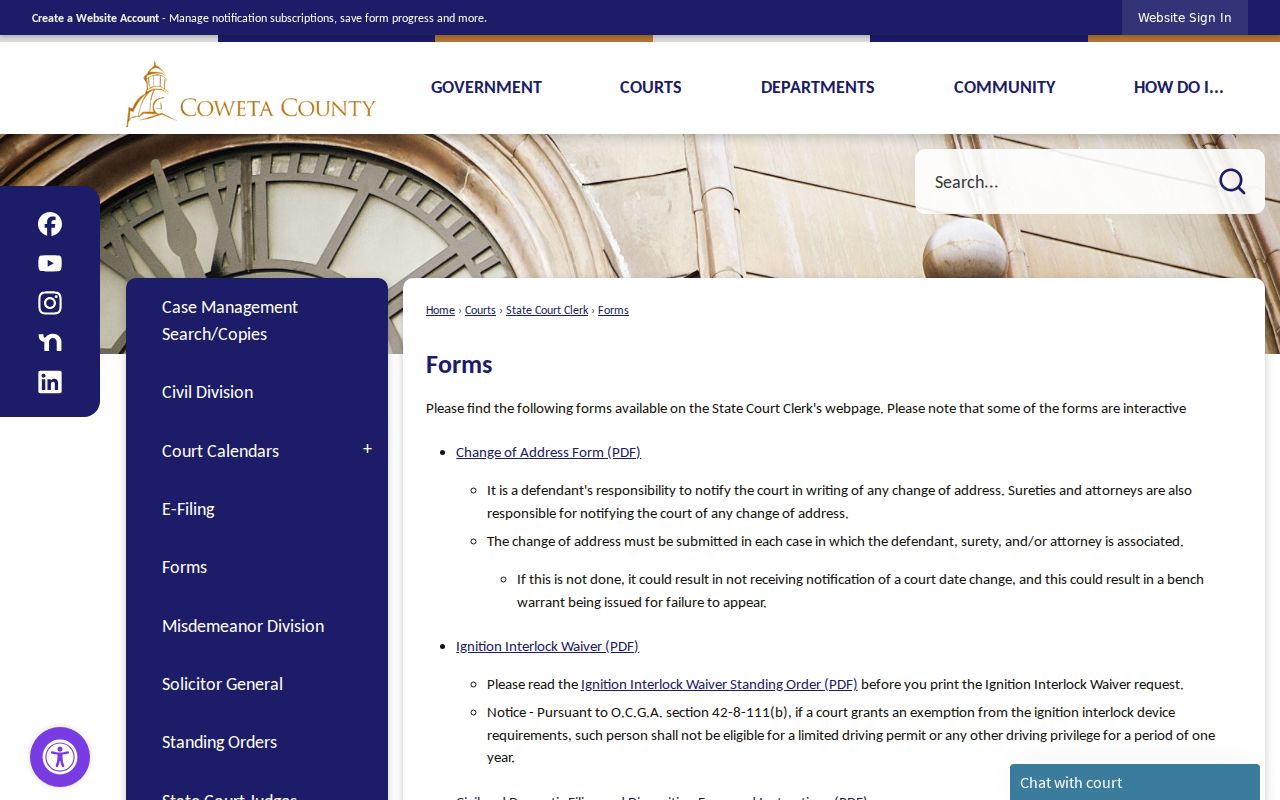
That official page ties court-record access to the county's separate form workflow. The correct clerk still decides whether a filed form, copy, or certified record can be released.
- State Court civil, criminal, traffic, calendar, and proceedings records.
- Superior Court civil, domestic, criminal, order, and filing records.
- Juvenile delinquency, dependency, and related records subject to Article 9 confidentiality.
- Probate petitions, estate records, guardianship matters, licenses, and orders.
- Magistrate claims, answers, judgments, warrants, and hearing materials.
- Municipal citation and ordinance records kept by Newnan, Palmetto, Senoia, Grantville, or Chattahoochee Hills.
- Federal district and bankruptcy records searched through PACER rather than a county portal.
What Sheila Echols's Office Keeps
Sheila W. Echols serves as the Coweta County State Court Clerk. Her office keeps State Court civil, criminal, and traffic case-management inquiries. It also handles proceedings, monies, calendars, and filings. Staff will explain access and copy procedures. But they will not give legal advice. Note that the counter and mailing channel differ from a county administrative records request.
Niki Sewell is the Coweta County Superior Court Clerk. That office and Court Services handle Superior civil and criminal filing records. They also manage case files, calendars, recording, and document services. Name the court and record type on any request. It will land at the right desk.
Sheila W. Echols, State Court Clerk
72 Greenville Street
Newnan, GA 30263
P.O. Box 884, Newnan, GA 30264
770-254-2699
Fax 770-252-6422
Monday through Friday, 8 a.m. to 5 p.m.
Niki Sewell, Superior Court Clerk
72 Greenville Street
P.O. Box 943, Newnan, GA 30264
770-254-2690
Fax 770-254-3700
Court Services 770-254-2695
Monday through Friday, 8 a.m. to 5 p.m.
Both offices take questions by counter, phone, and mail. A clerk can point you to the access path, copy type, and current schedule. Staff cannot pick a legal response or interpret another person's rights.
What a Court Record Contains
A Coweta court record can hold several pieces. These include the register, calendar information, filed papers, signed orders, and supporting materials. The county's civil calendars list report, court or division, date and time, judge, location, case number, cause, item, filing date, remarks, and party role. An attorney or self-represented notation appears there too. The criminal calendar fields cover report, court type, judge, item, attorney, count, and defendant field. Case number and offense or code count finish it.
Those labels help you request the right item. They also spare readers from copying private names into a public example. Keep two cautions in mind. A calendar field is not always a file document, and an offense or count field is not itself a final disposition.
| Case Number | The court identifier connecting filings, events, settings, and orders. |
|---|---|
| Docket or Register | A chronological record of procedural entries and case activity. |
| Calendar Setting | Date, time, judge, location, report, item, and setting category when published. |
| Pleadings and Motions | Petitions, complaints, answers, motions, briefs, and other filed papers. |
| Orders and Judgments | Signed rulings, judgments, continuance orders, assignments, or other court directives. |
| Exhibits and Attachments | Materials filed with a pleading or offered in a proceeding, subject to access limits. |
| Party and Counsel Roles | Caption, plaintiff or defendant role, attorney, or self-represented notation shown in the accessible record. |
Ask the clerk about format. The item may come as a plain copy, electronic copy, certified copy, or exemplified copy. A receiving court or agency can demand a particular authentication level, and the clerk can identify the correct form.
PeachCourt Is a Provider, Not the Docket
PeachCourt and Odyssey eFileGA are tools, not the official Coweta County court docket. Coweta Court Services says so plainly. They matter for filing and document exchange. But a login screen or a filing receipt is not the county's live docket channel. The Georgia eAccess map points Coweta Superior Court to PeachCourt and Coweta State Court to Tyler ResearchGA. The provider you land on depends on the branch.
One civil calendar entry carries the remark "CREATED FROM IMPORT FROM PEACHCOURT." That mark reflects a provider feeding data into a calendar workflow. It does not make the provider the official county register. It does not promise that every filing or event is visible. You may need the right account or a clerk request.
If a provider view and a clerk record disagree, write things down. Note the court, case number, source, and date. Then ask Court Services which record controls. A provider access gap may just be a login or technical issue. Do not call it a sealed or missing court file without confirmation.
Certified Copies and Fees
Coweta sets separate charges for copies. There are ordinary copies and assisted copies. Certification, exemplification, fax or electronic delivery, and retrieval get their own rates. Certification means a clerk stamps or seals the copy. Exemplification is a higher level of authentication, billed per seal. Before paying for the costlier option, ask first. Check which form the receiving court or agency actually requires.
| Item | Published Coweta Amount |
|---|---|
| Ordinary copy without assistance | $0.50 per page |
| Ordinary copy with assistance | $1 per page |
| Certified or exemplified copy stamp/seal | $2.50 stamp/seal plus $0.50 each additional page |
| Exemplified copy additional authentication | Add $1 per seal |
| Fax or electronic copy | $2.50 for the first page plus $1 each additional page |
| Retrieval from storage or retention | $5 retrieval charge |
The county's Case Management Search/Copies fee schedule is the source for these rates. Schedules change. A provider charge is not a clerk copy fee. Neither is an Open Records production cost or a PACER page fee. Confirm the current total with the office that holds the record. Ask about payment method, page count, and certification level too.
NextRequest for an Existing County Record
For an existing county-held record, Coweta's Open Records NextRequest portal is one route. It is not a universal court case index. Nor does it take custody of those court files. State, Superior, city, federal, Juvenile, Probate, and Magistrate files stay with their own courts. When a court offers a normal copy or inspection process, start with that clerk. The portal shows the county's request channel for records. It is not a docket-search result.
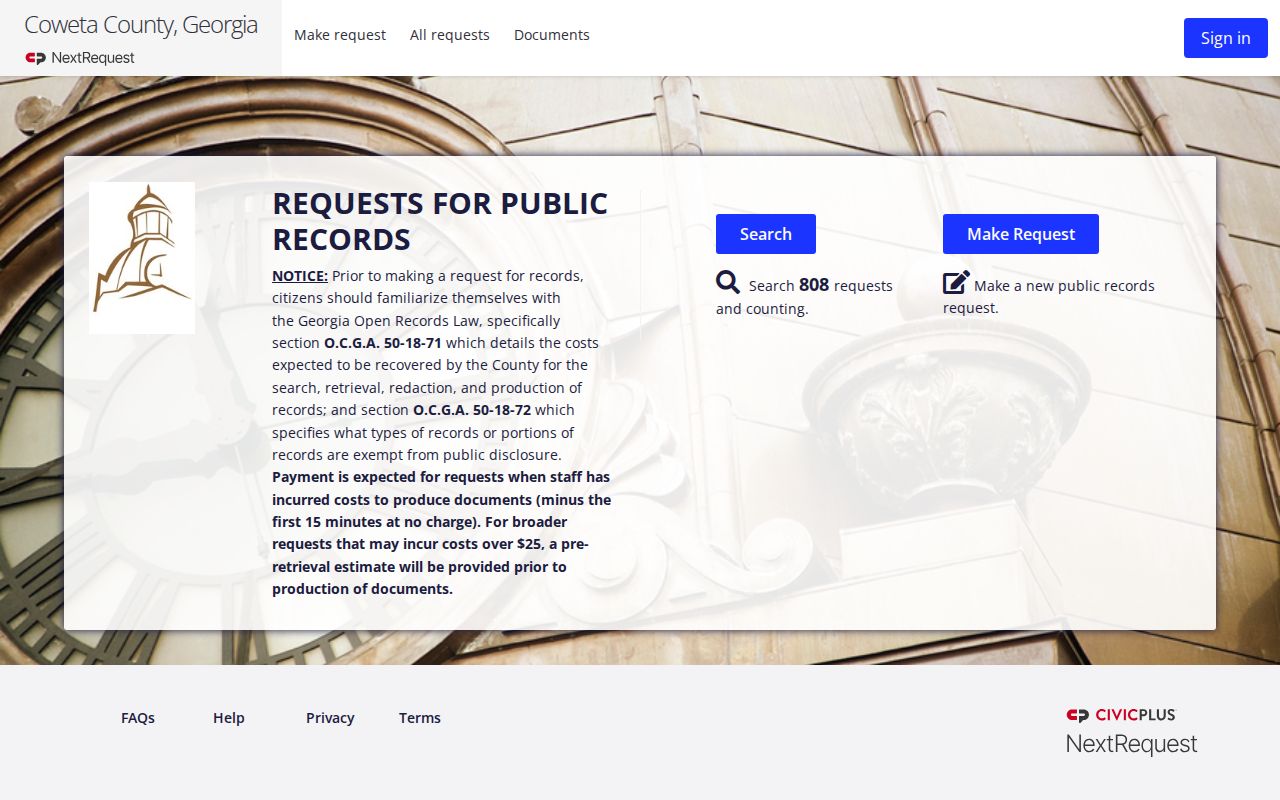
The portal cites the Georgia Open Records Act and O.C.G.A. sections 50-18-71 and 50-18-72. Under the documented cost rule, production charges kick in after the first 15 minutes. Estimates are required for broader requests over $25. Requests can arrive by fax, email, in person, phone, web, mail, or import.
Aim your request at a record that already exists. A docket, calendar, order, filing, or other identified document. Give the court, case number or date range, record type, and format you want. The agency will not build new reports. No summary or compilation is required from scratch.
Rule 22 and Courtroom Recording
Walking into a courtroom is not permission to record, photograph, or use every device. Coweta's Rule 22 notice governs Superior Court access. It also covers personal electronic recording. Send the request early when possible. At least 24 hours before the proceeding is best. Remember, a recording is not the official court record. Violations can bring removal or contempt.
The county's Rule 22 request form lays out what a device or recording request needs. That process is separate from asking the clerk for a docket or copy.
| Case style or number | Identifies the proceeding for which access is requested. |
|---|---|
| Courtroom and proceeding | States the room and the portion or type of proceeding involved. |
| Device type | Describes the camera, recorder, or other electronic device. |
| Start and use time | Gives the requested start date and time and the use date and time. |
| Responsible personnel | Names the people responsible for operation and compliance. |
| Requester or agency | Identifies the requester and affiliated organization when applicable. |
| Email, phone, signature, order | Provides contact, signature, and the judge-order portion of the request. |
Public Access and Sealed Records
Rule 21 opens with public access to Superior Court records. Still, a court can limit a record when law or procedure supports a specific order. That order should name the protected part. It should also state the reason, the duration, and the legal basis. A technical 403 or 404 proves nothing about sealing. Neither does a provider login wall or a missing calendar entry.
Georgia's record restrictions under O.C.G.A. section 35-3-37 govern specified criminal-history access. They carry their own eligibility rules and process. Juvenile records fall under Article 9 confidentiality rules. The Coweta Juvenile Court is not an open public name-search branch. JDEX serves authorized users rather than a public name lookup. Sealed federal documents stay hidden from PACER.
Public-access rule: Ask the court or clerk that maintains the file what is public, what is redacted, and what legal process applies. Do not copy juvenile details, protected identifiers, or sealed federal documents into a general request.
Uniform Superior Court Rules provide the Rule 21 public-access and sealing framework.
Coweta's courts split records among many offices. So the first question is always who holds the file. State and Superior clerks, municipal clerks, the Probate and Juvenile offices, Magistrate Court, Accountability Courts, and federal systems each control their own records and access decisions.
TrueFiling, Tyler, ICON, and PeachCourt
A provider name signals a filing or access channel, not one universal public docket. Coweta's e-filing information separates State civil Tyler support. It also lists State criminal and traffic ICON or ez-filing routes. Superior access runs through PeachCourt and Tyler channels identified by Georgia Courts. Probate information names TrueFiling. Each provider carries its own account, filing, payment, and document rules. Those rules may differ from the clerk's docket and copy process.
| Branch or Provider | Documented Role | Public-record Limit |
|---|---|---|
| Tyler eFileGA | State civil e-filing route and support | A filing landing page is not the official real-time docket |
| ICON or ez-filing | State criminal and traffic e-filing route | A filing receipt does not establish a complete public case history |
| PeachCourt and Tyler channels | Superior Court provider access and filing integration | Coweta Court Services says the provider is not the official docket |
| TrueFiling | Probate e-filing information | Probate records remain with the Probate Court and its access rules |
The county's e-filing information also notes that a rejected filing can stem from vendor or court reasons. When the question is whether a docket entry, order, or certified copy exists, check the clerk or Court Services.
The Coweta Magistrate nCourt e-filing route displays Statement of Claim and Answer to Claim categories. It describes a five-to-seven-step filing process. That page is a filing route, not a full public Magistrate docket.
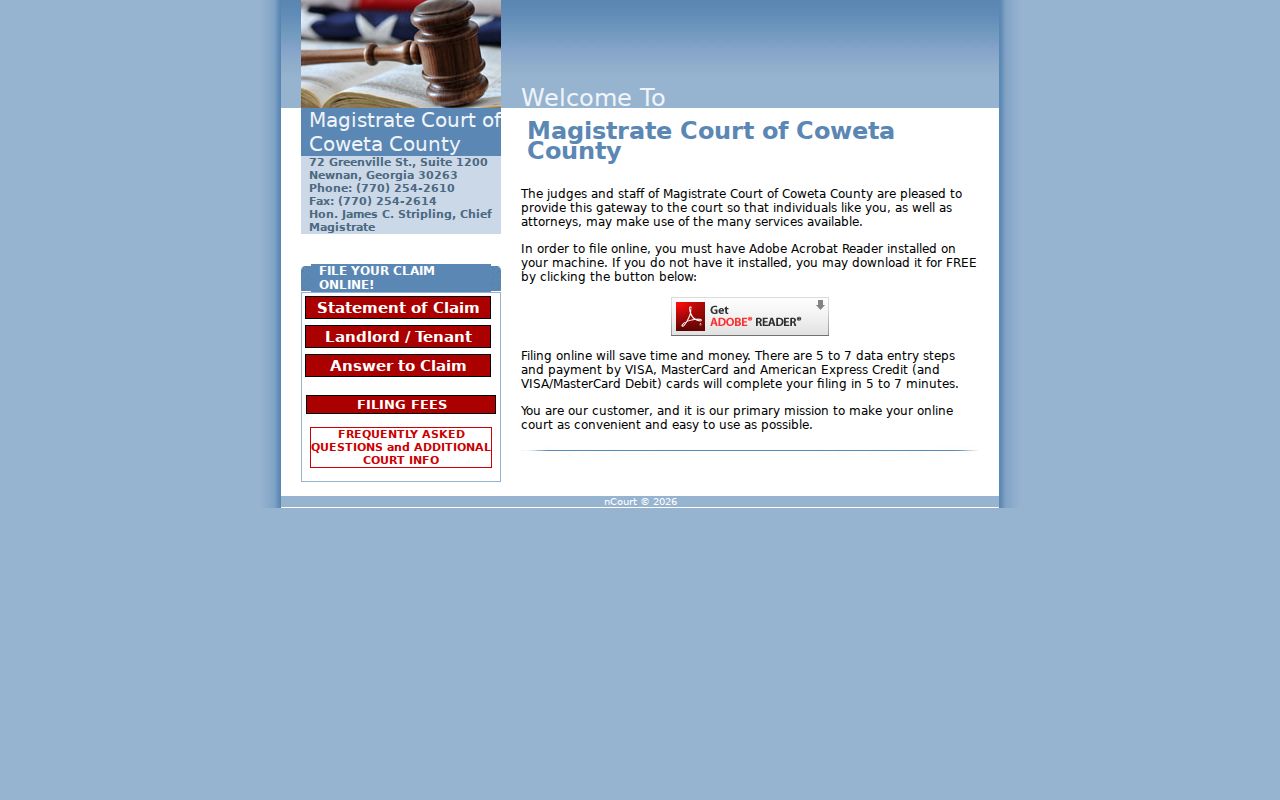
The Magistrate page underlines the gap between submitting a filing and getting the court's full record. For the case file and copies, go to the Magistrate office.
When a Request Needs a New Report
Sometimes a request simply asks too much. Under the Georgia Open Records Act, you can ask for records that already exist. You cannot force an office to merge files from separate court systems. Nor can you make it run a fresh calculation, or build a report nobody keeps. The State Court Clerk's public notice puts it plainly: an agency does not have to create a new report, summary, or compilation. That rule matters when your ask goes beyond what any desk in the courthouse actually holds.
So work with what exists. Request the docket sheet. Ask for the calendar PDF, an order, a filing, a case export, or a copy. Say which court and what date range you need. State whether you want a plain, electronic, certified, or exemplified version. Being specific has a side benefit too. It keeps a clerk copy fee separate from an Open Records production estimate.
One more thing about where records live. If the item sits with a city, a federal court, Probate, Juvenile, Magistrate, or a specialty program, send the request there. NextRequest handles existing county-held records fine. But it cannot conjure a universal Coweta case index or brush aside a confidentiality rule.